

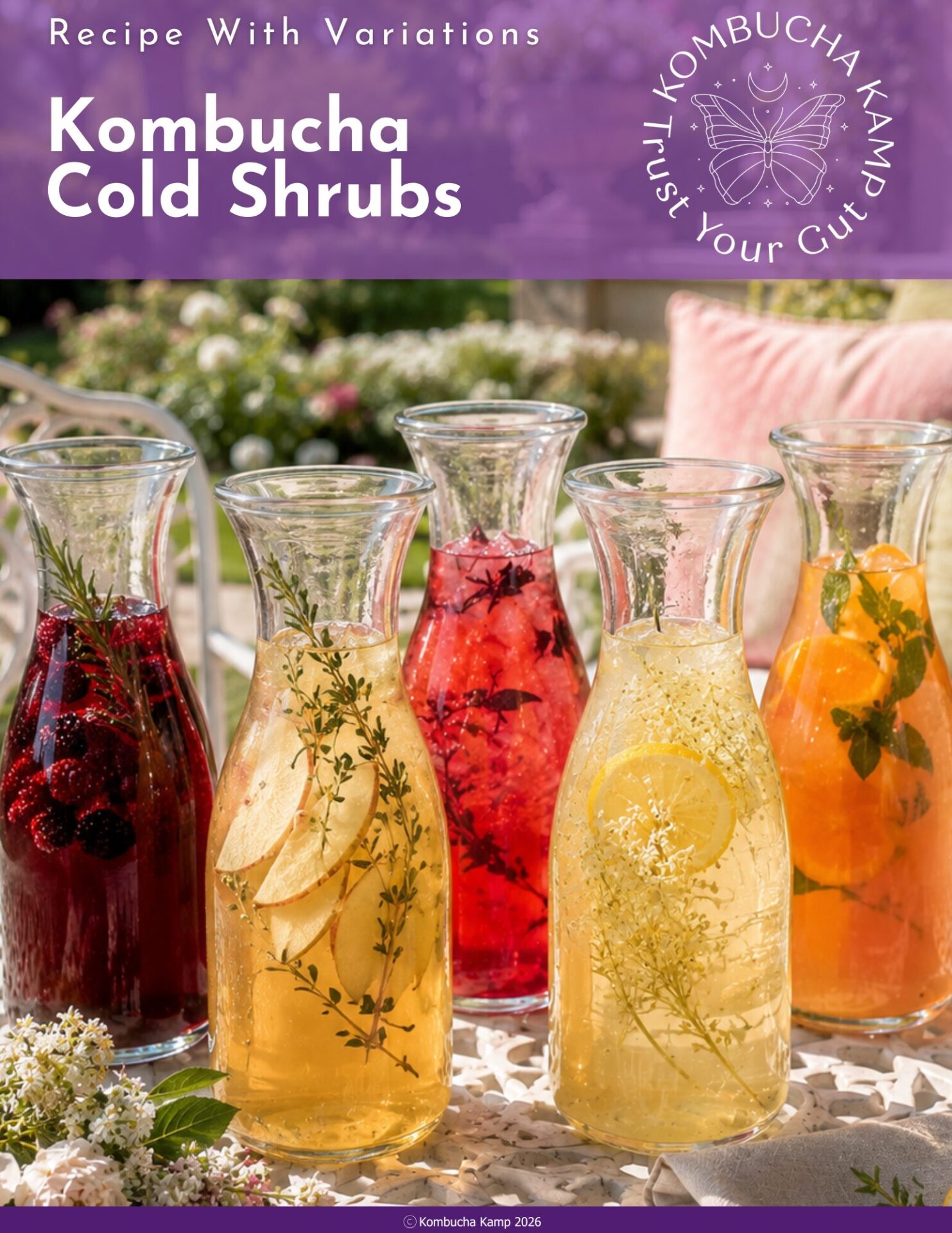
Cold Shrub Recipe Made With Kombucha Vinegar
Fermented Shrubs, Mocktails & Kombucha Cocktails
Shrubs are one of the oldest ways humans preserved fruit before refrigeration existed. Long before sodas, energy drinks, or neon cocktail syrups, people relied on fruit, sugar, and vinegar to create refreshing concentrates that could survive long winters, long voyages, and hot summer days.
Today, shrubs are experiencing a major revival thanks to the craft cocktail movement, fermentation culture, and growing interest in lower-sugar, flavor-forward drinks.
And Kombucha vinegar? It may be one of the most interesting shrub bases of all.
Unlike standard vinegar, Kombucha vinegar brings layered acidity, naturally occurring organic acids, live cultures, and complex fermented notes that pair beautifully with fruit, herbs, spices, sparkling water, cocktails, and mocktails alike.
The result is bright, tart, deeply customizable, and wildly refreshing.

Whether you’re making a sophisticated zero-proof mocktail, a probiotic soda alternative, or a full blown Kombucha Cocktail, shrubs are one of the easiest ways to elevate your fermentation game.
👉 Ready to Start your First Batch? Learn How to Brew Kombucha Here.
Quick Summary: Kombucha Shrubs
- Shrubs are fruit syrups preserved with vinegar
- Kombucha vinegar creates a softer, more complex shrub flavor
- Great for mocktails, cocktails, sodas, sparkling water, and party drinks
- Easy to customize with fruit, herbs, spices, and botanicals
- A useful way to preserve extra fruit seasonally
- Keeps for weeks or months refrigerated
- Excellent gateway recipe for beginners exploring Kombucha vinegar
What Is A Shrub?
A shrub is a sweet-tart drinking vinegar traditionally made from:
- Fruit
- Sugar
- Vinegar
The sugar pulls juice and flavor compounds from the fruit while the vinegar preserves the mixture and creates its signature tangy bite.
Historically, shrubs were consumed for:
- Hydration
- Food preservation
- Travel
- Flavoring water
- Cocktails
- Digestive support
- Seasonal fruit preservation
The word itself likely comes from the Arabic sharāb, meaning “to drink.”
In many ways, shrubs sit at the crossroads of:
- fermentation
- herbalism
- preservation
- culinary arts
- mixology
A tiny acidic time capsule in a bottle. 🍋
Why Use Kombucha Vinegar Instead Of Regular Vinegar?
Traditional shrubs usually rely on:
- apple cider vinegar
- white vinegar
- balsamic vinegar
- wine vinegar
But Kombucha vinegar produces an entirely different flavor profile.
Kombucha Vinegar Is:
- smoother
- fruitier
- less aggressively acidic
- naturally fermented
- layered with tea-derived tannins and acids
Because Kombucha vinegar is generally milder than standard vinegar, the ratio changes slightly.
Traditional shrub ratio:
- 1 part fruit
- 1 part sugar
- 1 part vinegar
Kombucha shrub ratio:
- 1 part fruit
- 1 part sugar
- 2 parts Kombucha vinegar
This creates a balanced shrub without overwhelming acidity.
What is kombucha vinegar?
Kombucha vinegar is simply Kombucha that has fermented long enough for acidity to continue developing beyond the normal drinking stage.
Instead of tossing an over-fermented batch, you can transform it into:
- shrubs
- marinades
- dressings
- pickling liquid
- hair rinses
- skin care preparations
- cleaning solutions
- mocktail bases
For shrub making, stronger vinegar generally works best.
How to make kombucha vinegar
Ingredients
- 1 gallon mature Kombucha
- 2 tsp sugar per pint, every 2 weeks
Method
- Begin with Kombucha already fermented at least 4 weeks.
- Add small amounts of sugar every 2 weeks to continue acid development.
- Allow fermentation to continue 6+ weeks total.
- Taste periodically until pleasantly sharp and vinegary.
- Store sealed or continue aging.
The resulting vinegar is softer than traditional vinegar but beautifully nuanced.

Bubbles Plus
Join Bubbles+ to access a growing library of premium recipes, brewing guides, fermentation classes, seasonal inspiration, and members-only resources from the world’s most trusted Kombucha educators.
Already a Member? Log In Here.






Marja Voges
September 23, 2022 at 8:16 pmHi, Hannah,
Have been brewing Jun in continuous brew method. How do I change the Jun to Kombucha, which I think I prefer.
Thank you, rgds
Marja
Anthea Tayag
September 28, 2022 at 12:47 pmWhile it is possible to transition a Jun SCOBY to brew Kombucha, the SCOBY may not be healthy in the long run. It may take several tries for the culture to acclimate to its new brewing situation or may go to mold. If you wish to try it out, you may follow our Kombucha Recipe and use a spare Jun SCOBY. https://www.kombuchakamp.com/kombucha-recipe
Maria
June 12, 2021 at 6:04 pmHi Hanna, what can I do with all my milk keifer that has gotten so big? My refrigerator has lot of jars with grains covered with milk and sugar, for storage. Should I just eat them or what? Also if I drain off the milk it’s been stored in for three to four or more weeks can you still drink it too or not.?
Maria
Hannah Crum
June 27, 2021 at 1:29 pmYes, you can eat them, blend into smoothies, compost, share with friends, give to pets, etc.
Christina
March 15, 2021 at 2:44 pmHi,
I got your book (which I am enjoying VERY much) and read about making the vinegar. I’m a little confused. Could you please walk me through a few things I’m not understanding?
1. Does the vinegar come about from the first ferment or do I process it as a second ferment and, during the second ferment, it becomes the vinegar (feeding it the sugar per the book’s directions)?
2. If a SCOBY forms, may I use it for a future brew or use it in a jerky or fruit leather recipe found in the book?
Thanks for your time and help,
Christina
Hannah Crum
April 2, 2021 at 6:01 pmWe consider it “Kombucha Vinegar” (KV) once its too sour to drink. That can be the result of a primary fermentation that has gone too long or we can increase the acidity by following the steps outlined in the book – both work.
Yes! Use the SCOBYs for jerky, face mask, compost, and more!
Robbin Klein
May 6, 2019 at 11:55 amhi all,
question regarding brewing kombucha vinegar: Should the brewing happen under normal breathable cover or air tight seal. Currently keeping the process under a breathable cover until i find out otherwise. Afraid of too much pressure from too frisky yeast and an epic geyser. Couldn’t find in your book and didn’t want to assume. Thanks for your help, Robbin
Hannah Crum
May 8, 2019 at 7:39 amAfter one stinky hotel experience, we realized that the cultures do best when a SCOBY is the lid and we use the cloth cover to prevent bugs or debris from getting into the jar. Closed tops will restrict oxygen flow which can lead to sick, smelly yeast. It can typically be recovered by exposing the jar to oxygen and the yeast will gradually rebalance. You are on the right track with the cloth cover!